Mental barriers & change
The door she could not open
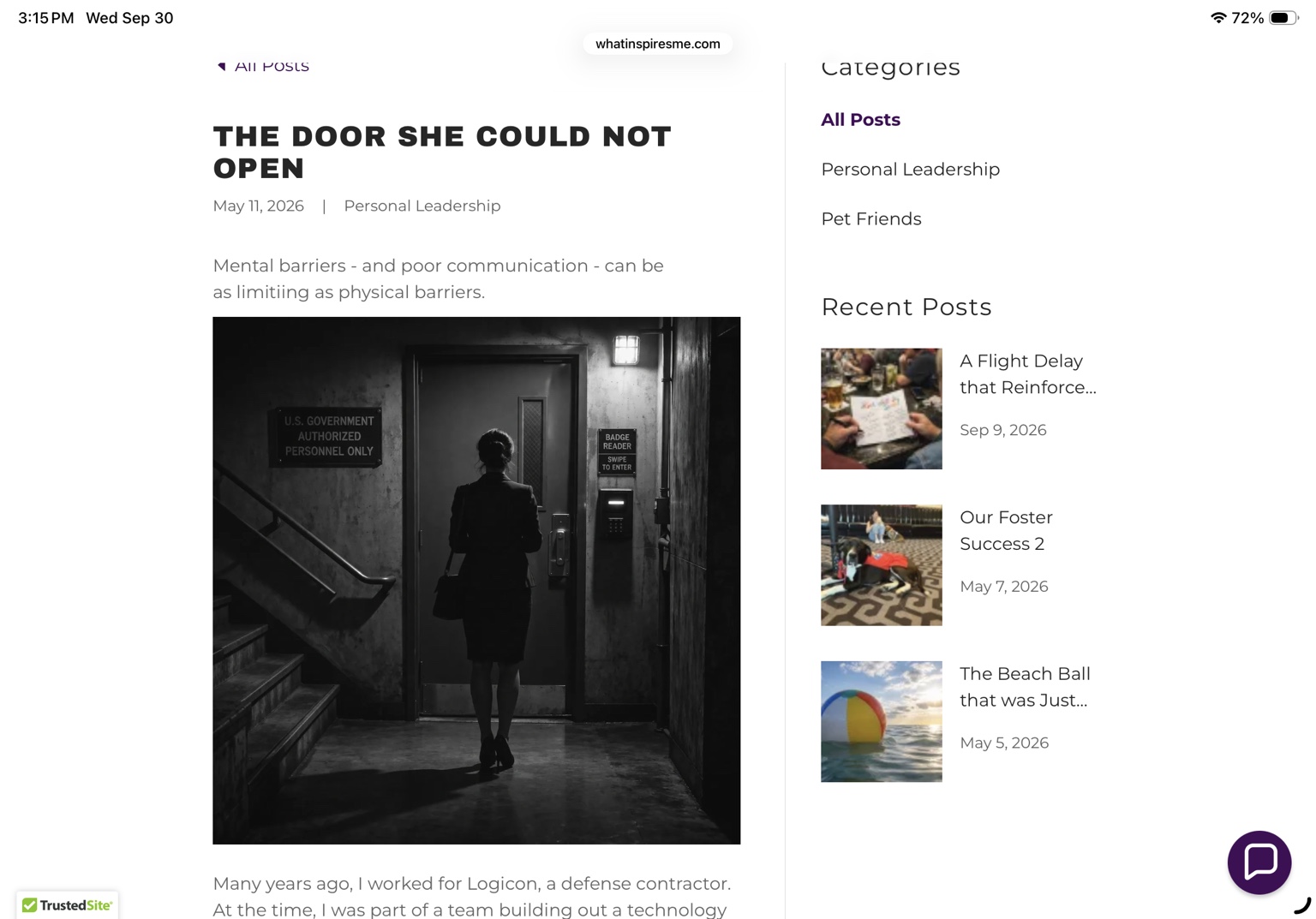
Many years ago, I worked for Logicon, a defense contractor. We were building out a technology room in the basement of a secure government facility. Concrete walls, fluorescent lights, heavy metal doors. If you have been in an older government building, you know the setting.
We had just installed a badge reader outside the room. It was mounted and wired, but it wasn’t active yet. The door was unlocked.
I was carrying several heavy pieces of computer equipment down the stairs. This was the 1990s, when moving computer equipment was also a strength-training exercise. My hands were full, and my patience was running low.
A woman in a business suit was just ahead of me. When we reached the room, I said, “Open the door.”
She looked at the badge reader. “I can’t.”
“Open the door,” I repeated.
“I can’t.”
We were both getting frustrated. “Just open the door!”
“I can’t. I don’t have a badge.”
Finally, I explained: “You don’t need a badge. The badge reader isn’t active yet. Just push the door open.”
She turned the handle and pushed. The door opened. I put the equipment down before my arms gave out.
For years, what stayed with me was how completely the badge reader had settled the question. She saw it, knew what it usually meant, and concluded that she couldn’t open the door. The door itself never got a vote.
That is what makes mental barriers so powerful. Once we accept that something cannot be done, we stop looking for a way to do it. An assumption can close off a possibility just as effectively as a lock.
Mental barriers can be just as limiting as physical ones.
I have seen this happen in organizations, especially during change. We carry forward what we learned under the old structure, the old process, or the old leadership. “That won’t get approved.” “Those teams don’t work together.” “We can’t do it that way.”
Maybe those statements were once accurate. But when the organization changes, the conditions behind them may change too. We can end up following rules that no longer apply, or honoring limitations that nobody is still imposing.
The useful question is: Do we know this is still a barrier, or are we assuming it is because it used to be?
That doesn’t mean ignoring rules or pretending every obstacle is imaginary. It means checking what actually stands in the way before deciding we are stuck.
Sometimes the door is locked. Sometimes we have already decided it is.
Adapted from “The Door She Could Not Open,” first published on What Inspires Me.
← Back to Stories from the Work