Leadership & organizational change
Three Keys to Succeeding in a Time of Change
Lessons from a career of reorganizations, mergers, and figuring out what happens next.
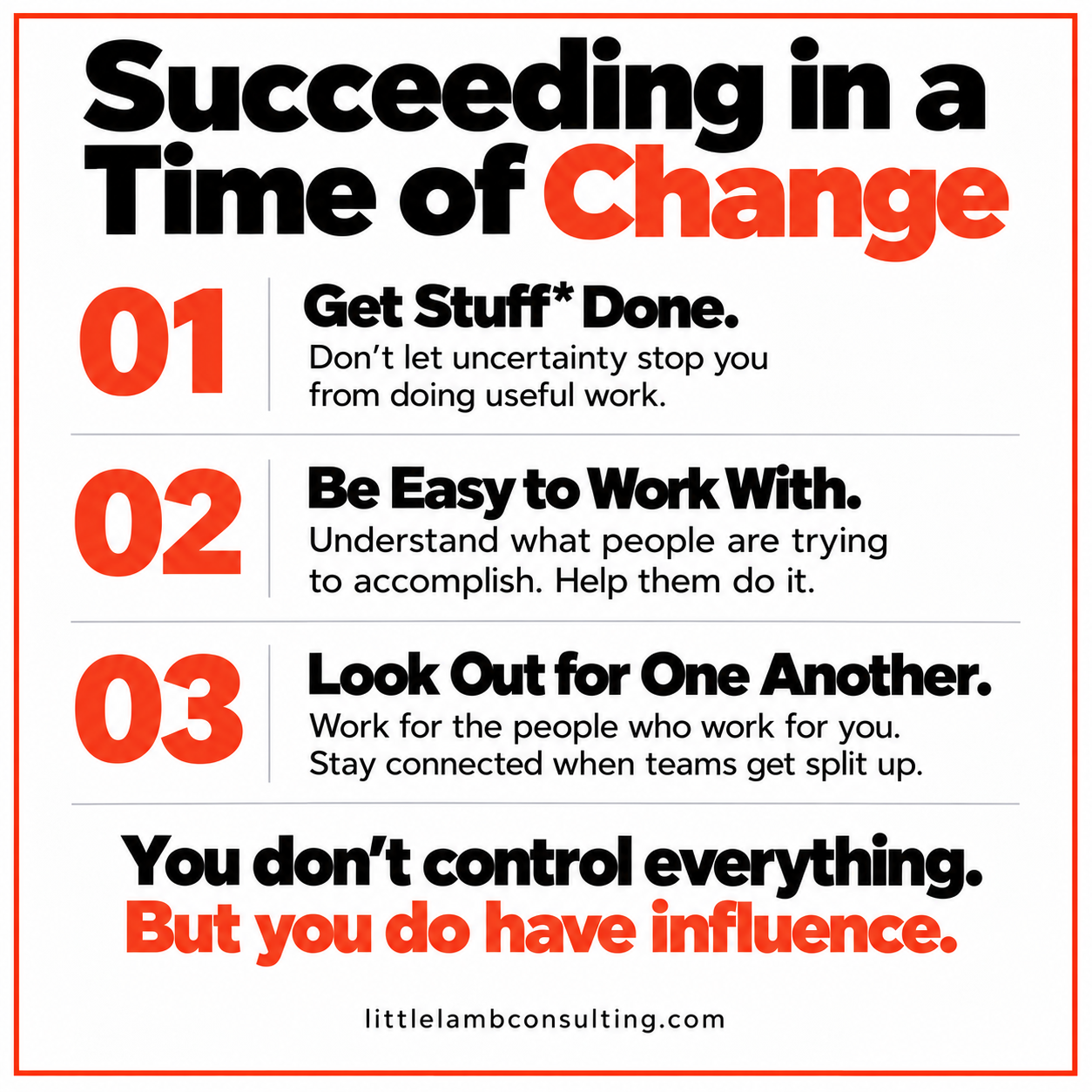
Over my career, I experienced many changes, from reorganizations to corporate mega-mergers. I went from Nextel to Sprint to XOHM to Clearwire, back to Sprint, and eventually to T-Mobile. Some transitions were exciting. Some were uncomfortable. There was usually plenty of uncertainty.
The questions were often familiar. Who would be in charge? How would the teams fit together? Which priorities would survive? And, of course, what would it mean for each of us?
Along the way, I developed three rules that I shared with my teams. They didn’t guarantee that everything would work out. But they gave us something useful to focus on when we couldn’t control what was happening around us.
1. Get Stuff* Done
*Sometimes I used a different word than stuff.
There used to be a children’s toy called the Sit ’n Spin. You sat on a round platform, turned the wheel, and spun yourself around. You could put a lot of effort into it without actually going anywhere.
I found that organizational change could have the same effect on adults.

We speculate about the new organization, revisit the same unanswered questions, and wait for somebody to tell us what happens next. It’s understandable. We’re worried about our jobs, our teams, and whether the work we’re doing will still matter.
But we can sit and spin for too long.
You don’t need the final org chart to solve a customer problem, help a colleague, or finish something useful. There is usually work you can move forward, even when you can’t see the whole picture.
That doesn’t mean charging ahead blindly or pretending nothing has changed. Some work should pause. Some decisions need more information. The point is to make that distinction, rather than letting uncertainty put everything on hold.
Find work worth doing with what you know now. Take initiative. Then adjust as you learn more.
2. Be Easy to Work With
This might be the most important one, especially when you’re joining a new organization.
Being easy to work with doesn’t mean politely saying no. It means understanding what somebody else is trying to accomplish and actively helping them accomplish it.
That takes more effort than being pleasant. You have to be curious about what matters to the other person, especially when their request doesn’t make sense to you at first.
Find out what they need and why. You may not be able to do exactly what they ask, but you may see another way to get there. Take some responsibility for helping them succeed.
During a merger or reorganization, people bring different histories, habits, and ways of working. What seems obvious to one team may be completely unfamiliar to another. Explaining how we did things in the old organization only gets us so far. We still have to figure out how to work together in this one.
People are learning whom they can count on. Give them an experience of working with you that makes them want to do it again.
3. Look Out for One Another
Change can scatter a team pretty quickly. People you worked with every day may end up in different organizations. Others may leave the company. The regular contact disappears, even though the relationships still matter.
It’s easy to lose touch without ever deciding to. The meeting goes away. The reporting line changes. Everybody is busy figuring out their own situation. Before long, you realize you haven’t spoken to someone in months.
Check in. Make an introduction. Share an opportunity. Don’t assume that because somebody seems fine, they don’t need to hear from you.
And if you lead people, work for the people who work for you.
You may not be able to give them certainty. You may be trying to sort through the same unanswered questions yourself. But you can listen, be honest about what you know and don’t know, and help them think through their options.
Looking out for people shouldn’t stop just because they no longer report to you.
No Guarantees
I never told my teams that following these rules would make them immune to a bad outcome. Good people doing good work can still be affected by decisions they had no part in making.
That matters. These aren’t rules for making yourself indispensable, and they aren’t a judgment on somebody whose job was eliminated. Sometimes the outcome is outside your control.
But you do have influence over the work you do, how you help others, and whether you stay connected. These were three practical ways to use it.
Get stuff done. Be easy to work with. Look out for one another.
Those were my three rules. They still are.